
This article is a direct follow-up to our previous in-depth coverage of the US strikes on Iran’s nuclear facilities and their impact on global markets and investor strategy.
The 24-Hour Ceasefire: How Trump's "12-Day War" Reshaped Middle East Markets
The financial world watched with intense focus as President Trump announced what he called the end of a "12-Day War" between the US, Israel, and Iran. This unprecedented conflict, marked by direct US strikes on Iranian nuclear facilities, created massive waves across global markets and reshaped investor sentiment toward Middle East geopolitics.
What Happened: From Nuclear Strikes to Fragile Peace
The crisis escalated dramatically when the United States launched its first direct military action against Iran, targeting three key nuclear sites: Fordow, Natanz, and Isfahan. Trump declared these facilities were "obliterated," using powerful bunker-buster bombs to penetrate Iran's deeply buried enrichment centers.

Map showing the locations of Iran's key nuclear and military facilities aljazeera
Iran's response came swiftly, launching multiple missile barrages at Israeli cities, including a devastating strike on Beersheva that killed six people. The final Iranian salvo occurred just minutes before Trump's announced ceasefire deadline, highlighting the fragile nature of the agreement.
The ceasefire announcement itself raised questions about its durability. Trump coordinated with Qatar to broker what he termed a "complete and total ceasefire," but neither Iran nor Israel formally acknowledged the agreement. This uncertainty kept markets on edge even as the immediate fighting paused.

Traders on the New York Stock Exchange floor react to market developments, reflecting the impact of global events on financial trends seattletimes
How It May Escalate The Conflict
Despite the announced ceasefire, several factors could trigger renewed escalation and potentially draw the region into a broader war. Iran finds itself in a weakened position with few viable exit strategies, creating dangerous incentives for desperate measures.
Nuclear Program Reconstruction: Iran's nuclear breakout time remains virtually zero, with enough material for nine nuclear weapons if further enriched to 90%. The recent strikes destroyed infrastructure but not Iran's nuclear knowledge or remaining stockpiles. Iran could rapidly rebuild enrichment capacity within 4-5 months under JCPOA-type limits, or produce enough weapons-grade uranium for one bomb in just 25 days using existing capabilities.
Regional Proxy Activation: Iran may activate its network of regional proxies, including Hezbollah in Lebanon and Houthis in Yemen, to pressure Israel and the U.S. indirectly. This "Axis of Resistance" strategy allows Iran to escalate without direct confrontation while maintaining plausible deniability.
Strait of Hormuz Threat: Iran's parliament has already authorized closure of the Strait of Hormuz, which handles 20% of global oil shipments. Any attempt to block this critical chokepoint would force direct U.S. military intervention and could trigger oil prices above $100 per barrel.
Threshold War Dynamics: The conflict represents a dangerous new form of "threshold war" where a nuclear power seeks to prevent an enemy from acquiring nuclear weapons. This creates an inherently unstable escalation spiral where Iran increasingly believes it cannot deter Israeli aggression without nuclear weapons, yet every step toward acquiring them invites more aggressive strikes.
Domestic Pressure: Iran's regime faces internal dissent and economic strain, potentially pushing leaders toward external confrontation to distract from domestic problems. The combination of nationalist rhetoric and external threats helps the regime maintain power but increases escalation risks .

Nuclear Contamination Risks: Limited But Present
Experts quickly assessed the radiation risks from strikes on Iran's nuclear facilities. The International Atomic Energy Agency confirmed that while radioactive contamination occurred within the targeted sites, radiation levels outside the facilities remained normal.
The main concerns centered on chemical rather than radiological hazards. Uranium hexafluoride gas released from damaged enrichment facilities posed localized risks to nearby populations, but experts emphasized these dangers were contained and not comparable to disasters like Chernobyl.
Most concerning was the potential impact on Iran's Bushehr nuclear power plant, which experts warned could cause a "significant radiological disaster" if attacked. Fortunately, this operational reactor remained untargeted during the conflict.
How It May Affect the US Economy
Oil Markets Show Surprising Resilience
Despite initial fears of major supply disruptions, oil markets demonstrated remarkable stability. West Texas Intermediate crude rose only 0.2% to $74 per barrel, while Brent crude reached $76. The key factor preventing massive price spikes was Iran's decision not to close the Strait of Hormuz, which handles 20% of global oil shipments.

Economic Impact Analysis: Middle East Crisis Market Effects Across Key Sectors
Energy analysts outlined three potential scenarios for oil prices: a contained conflict keeping prices around $75-80, regional escalation pushing prices to $85-100, or full escalation driving prices above $100 per barrel. Currently, markets are pricing in the most optimistic scenario.
US equity markets showed mixed reactions to the crisis. The S&P 500 fell 0.22% while the Dow Jones managed a slight 0.08% gain. The tech-heavy Nasdaq declined 0.51%, reflecting investor uncertainty about prolonged geopolitical tensions.
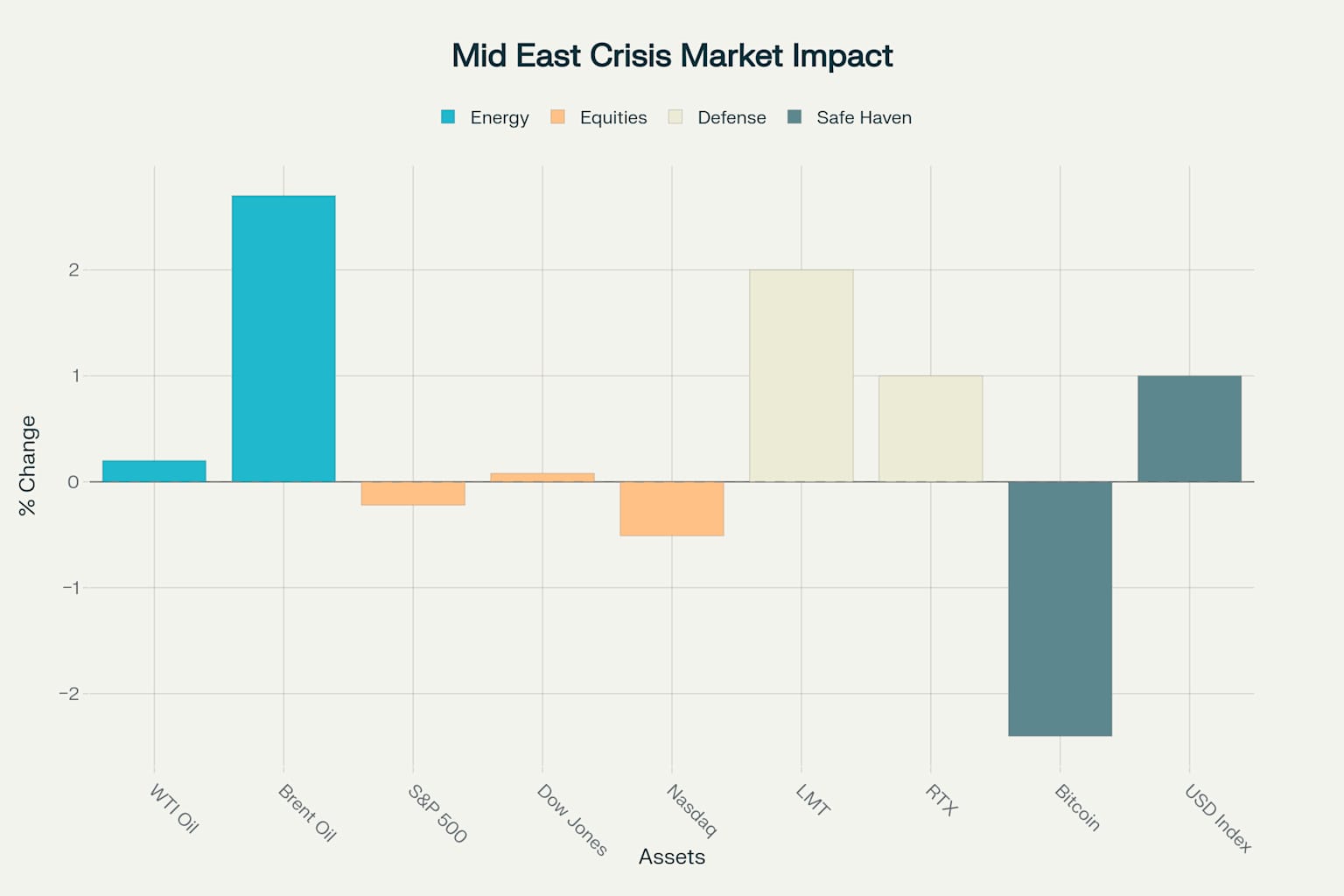
Market Impact Analysis: Asset Performance During Middle East Crisis by Category
Defense contractors emerged as clear winners, with Lockheed Martin gaining 2% and Raytheon up 1%. However, these gains were more modest than expected, as markets viewed the conflict as contained rather than a long-term engagement requiring massive defense spending.
Economic Impact Assessment
The broader economic implications remain significant. Capital Economics warned that a wider regional war could cut global growth by 0.4% and increase inflation by 1.5%. For Israel, the conflict's daily cost reached $200 million, equivalent to 5% of its annual GDP.

Investor analyzing stock and commodity charts on multiple screens amid Middle East crisis market volatility reuters
The crisis also highlighted vulnerabilities in global supply chains, with maritime insurance costs rising 30% due to attacks by Iranian-backed Houthis in the Red Sea.
How To Mitigate Risks
Following the economic impact analysis, investors and businesses need concrete strategies to protect themselves against Middle East volatility while positioning for potential opportunities.
Portfolio Protection Strategies
Diversification Across Geographies: Reduce exposure to Middle East-sensitive assets by diversifying into markets with minimal regional exposure. Focus on developed markets in Europe, Asia-Pacific, and North America that are insulated from direct conflict effects.
Defensive Asset Allocation: Maintain 30% allocation to defensive sectors including utilities, healthcare, and consumer staples. These sectors typically outperform during geopolitical crises due to stable demand patterns.
Energy Hedging: Limit direct energy exposure to 15-20% of portfolios while using derivatives to hedge against oil price spikes. Consider short-dated put options on crude oil to profit from potential price declines if tensions de-escalate.
Safe Haven Positioning
Gold and Precious Metals: Allocate 10-15% of portfolios to gold and gold ETFs as inflation and geopolitical hedges. Gold historically outperforms during Middle East conflicts and currency debasement periods.
Government Bonds: Increase allocation to high-quality government bonds, particularly U.S. Treasuries, which benefit from safe-haven flows during crisis periods. However, monitor inflation impacts from higher energy costs.
Currency Hedging: For international investors, hedge currency exposure to oil-importing economies that face balance of payments pressures from higher energy costs.
Active Risk Management
Dynamic Rebalancing: Monitor diplomatic developments and adjust allocations as risks shift. Track U.S.-Iran negotiations, IAEA reports, and oil inventory data for early warning signals.
Volatility Trading: Use the CBOE Crude Oil Volatility Index to gauge market expectations and time entry/exit points. Current volatility levels match March 2022 post-Ukraine invasion peaks.
Supply Chain Diversification: For businesses, reduce dependence on Middle East shipping routes and energy inputs. Consider "friend-shoring" supply chains to allied nations less exposed to regional conflicts.
Scenario-Based Planning
Stress Testing: Conduct regular portfolio stress tests using oil price scenarios ranging from $65 (ceasefire holds) to $130+ (Strait of Hormuz closure). Model impact on different asset classes and adjust allocations accordingly.
Contingency Planning: Prepare for three key scenarios: contained conflict (maintain current hedges), regional escalation (increase defensive positioning), and full escalation (maximize safe havens and reduce risk assets).
Liquidity Management: Maintain higher cash positions to take advantage of market dislocations and ensure ability to rebalance quickly as conditions change. Target 15-20% cash allocation during peak uncertainty periods.
The key to navigating Middle East volatility is maintaining flexibility while avoiding overreaction to daily headlines. Focus on fundamental risk factors - oil supply disruption probability, diplomatic progress indicators, and economic data - rather than political rhetoric.
What To Expect Next: Three Critical Scenarios
Scenario 1: Contained Conflict (60% Probability)
This most likely outcome sees both sides respecting the ceasefire while pursuing diplomatic solutions. Oil prices would stabilize around current levels, and markets would gradually return to normal trading patterns. Defense spending would remain elevated but not surge dramatically.
Scenario 2: Regional Escalation (30% Probability)
Iran rebuilds its nuclear program while Israel continues targeted strikes. This scenario could push oil prices to $85-100 per barrel and trigger moderate global economic slowdown. Defense stocks would see sustained gains as regional tensions persist.
Scenario 3: Full Escalation (10% Probability)
Iran withdraws from the Nuclear Non-Proliferation Treaty and accelerates weapons development. This worst-case scenario could close the Strait of Hormuz, spike oil above $100, and trigger global recession fears.
Investment Implications
Smart investors should consider several key factors. Energy sector exposure remains attractive given ongoing supply risks, while defense contractors like Lockheed Martin and Raytheon offer targeted plays on regional tensions. However, avoid broad market bets until ceasefire durability becomes clearer.
The dollar's strength during the crisis reinforced its safe-haven status, while Bitcoin's volatility highlighted crypto's continued sensitivity to geopolitical shocks.
For now, markets are betting on Trump's diplomatic skills to maintain peace. But as history shows, Middle East ceasefires can be fragile. Investors should prepare for continued volatility as this "12-Day War" reshapes regional power balances for years to come.
The key lesson: in today's interconnected world, geopolitical events can create immediate market impacts, but smart money follows the fundamentals rather than headlines.
